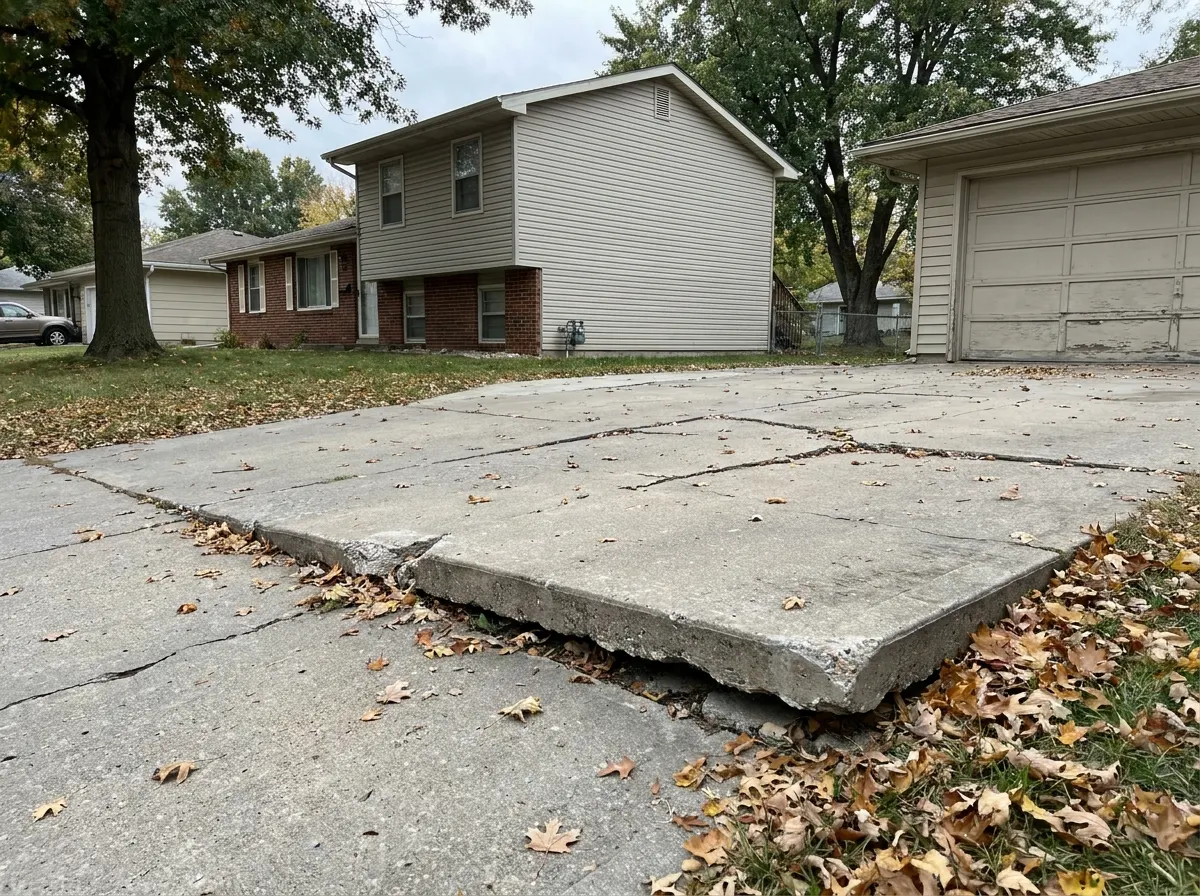
Why slabs sink in Omaha
Omaha sits on loess, a fine wind-blown silt, with clay-rich subsoils beneath. The American Concrete Institute points to three main reasons slabs lose support: poorly compacted soil under the slab when it was first poured, soil that shrinks as it dries out, and erosion of the base material when water gets into it.
All three happen here. Loess washes out easily when water reaches it, which leaves gaps under slabs and streets. Omaha also averages about 135 nights a year below freezing, and the city's own Public Works department explains how water that freezes in cracks breaks up concrete over time. A sinking driveway, a settled patio, or steps that have dropped are often just the surface sign of a void that opened up underneath.
What slabjacking is, and the two main kinds
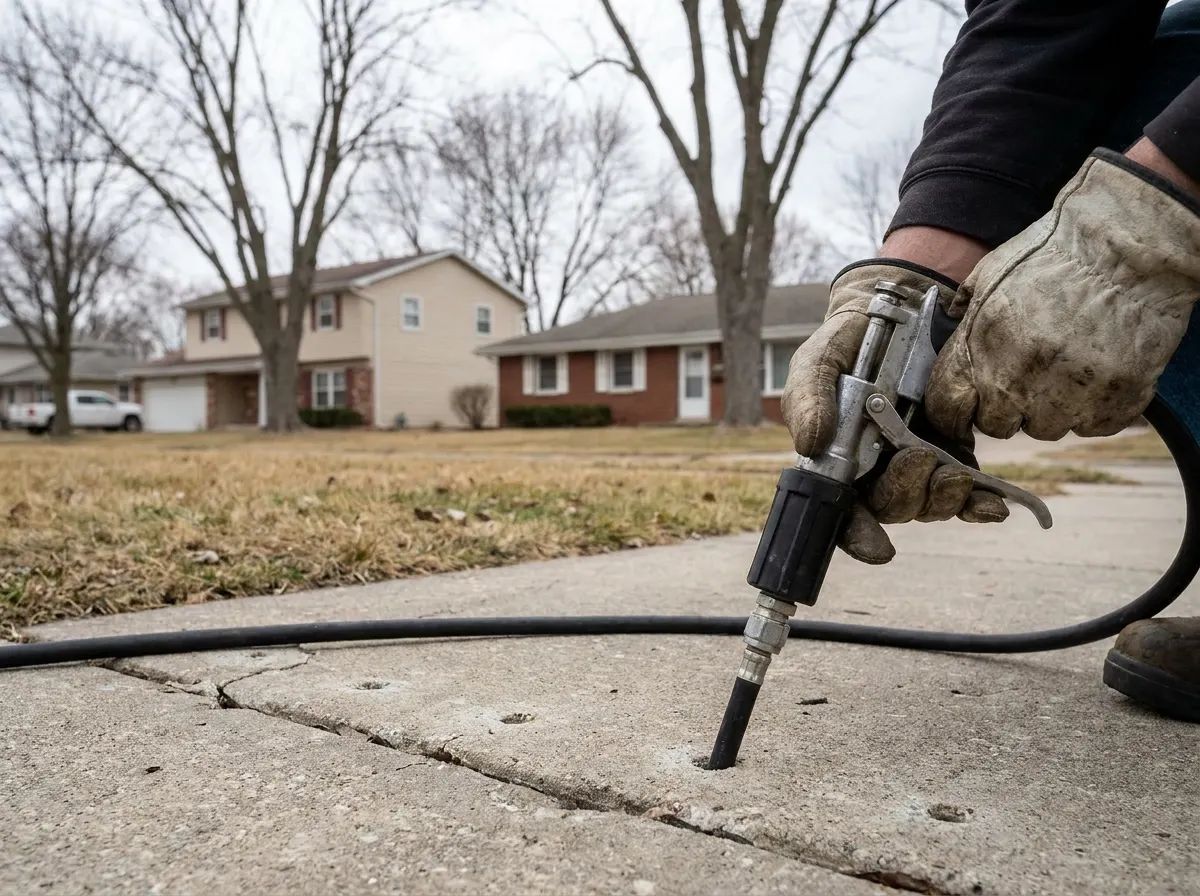
The American Concrete Institute defines slabjacking as raising a settled concrete slab, or filling the voids under it, by pumping a material underneath under pressure. Contractors generally offer two versions: mudjacking and foam leveling.
Mudjacking uses a cement-based grout, typically pumped through holes roughly 1-1/2 to 2-1/2 inches across. Foam leveling, sometimes called polyjacking, uses polyurethane foam injected through much smaller holes, about 1/2 to 3/4 inch across.
How they differ matters. The ACI notes that foam works faster and makes less mess, but because it reacts so quickly, the space under the slab often isn't completely filled. The ACI also notes that the extra weight of cement grout can itself cause more settlement on weak soil. Missouri's DOT manual adds that polyurethane is generally kept to raising slabs and filling smaller voids, not large ones, and that badly broken slabs can't be raised effectively regardless of method.
A contractor can look at your specific slab, the size of the void, and the condition of the concrete and tell you which approach makes sense.
The limits of leveling
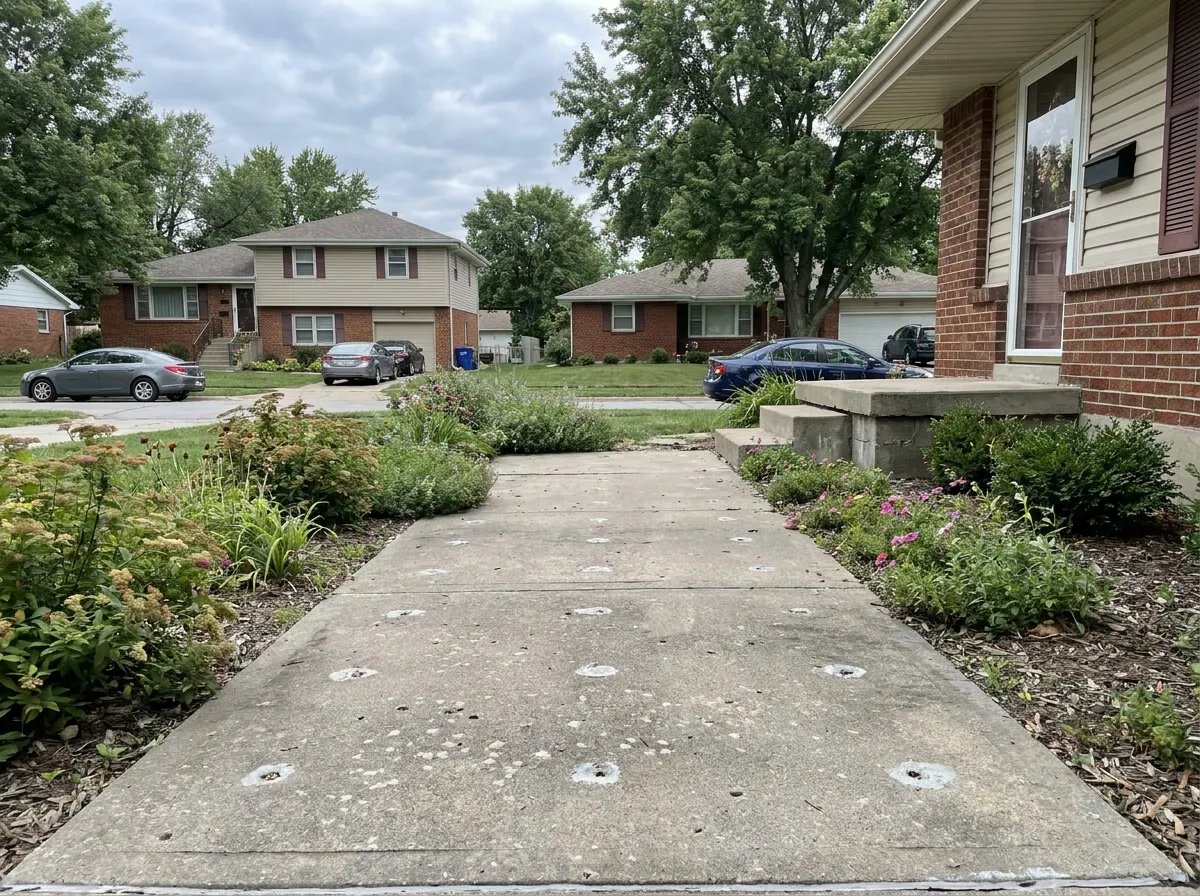
This is worth knowing before you commit. The ACI is direct about it: slabjacking levels the slab but does not fix the soil underneath. If the ground is still settling or washing out, the slab can sink again.
Leveling also won't make old cracks disappear. And the drilled holes stay visible after they are patched, even if they are small. Missouri's DOT notes that badly broken slabs can't be raised effectively, so for a severely broken driveway or walk a contractor may talk about replacing it instead.
That sunken slab isn't getting better on its own.
Every time someone walks up your front path, there's that little catch in your stomach. The raised edge, the tipped step, the guest who almost tripped.
A good local contractor can tell you whether mudjacking or foam leveling fits your slab. The goal is a level, safe walk without tearing it all out.
Talk to a Local ProYour call goes straight to one of the top-rated concrete leveling contractors in the Omaha area. Free quote, no pressure. Call (402) 807-0201
Omaha sidewalk and driveway rules worth knowing
In Omaha, the property owner is responsible for repairing unsafe sidewalks and deteriorated driveway approaches next to their property. That comes from the city's Public Works department. Omaha's code also says an owner who doesn't keep the abutting sidewalk in repair is liable for damages or injuries caused by its defective condition.
The city calls a sidewalk defective if, among other things, a joint or crack is faulted one inch or more, or the walk is raised or sunken more than two inches over eight feet. If Omaha sends you a sidewalk repair notice, you can hire your own contractor or let the city's contractor do the work and bill the property.
On permits: you need a permit from Omaha Public Works to build or repair a public sidewalk, and a separate permit to build or rebuild a driveway approach, which is the section between the street and your property line. Replacing your own driveway or private walk with one no bigger than before does not need an Omaha building permit, but that exemption does not cover the public sidewalk or the driveway approach.
Choosing a contractor
Before any drilling starts, ask whether the crew calls Nebraska811 for a utility locate. The ACI warns that grout can travel into sewers or utility lines underground, so this step matters.
For contractor verification, Nebraska requires contractors to register with the Nebraska Department of Labor. You can search the registry by name, city, or ZIP at dol.nebraska.gov. The state notes that registration does not ensure quality of work or protect against fraud, so use it as a starting point, not a guarantee. The BBB of the Midwest Plains, based in Omaha, is another resource for checking complaint history.
A few questions worth asking any contractor: What method do you recommend and why? What happens if the slab settles again? Do you carry liability insurance? Get the scope, method, and warranty terms in writing before work begins.
Older steps or a cracked foundation too? See mudjacking in Omaha and foundation repair in Omaha.
Frequently asked questions
Can a slab that has already been leveled once be leveled again?
Sometimes, yes, but it depends on why it settled the first time. If the underlying soil is still unstable or water is still getting under the slab, it can sink again after a second leveling. A contractor should assess the cause before recommending another round of slabjacking.
Is there a difference between foam leveling and polyjacking?
Polyjacking is another name people use for polyurethane foam leveling, where foam is injected under pressure through small holes to lift and stabilize a settled slab.
I got a city notice about my sidewalk. Do I need a permit to fix it?
Yes. Omaha requires a permit from Public Works to repair or replace a public sidewalk or a driveway approach. Replacing your own private driveway with one no bigger than before does not need a building permit, but the public sidewalk portion is a separate matter. A contractor familiar with Omaha's process can pull that permit.
Ready to stop tripping over that slab?
Call now or fill out the form and get connected with one of Omaha's top-rated concrete leveling contractors.